 Add to Chrome
 Add to Firefox
 Add to Edge
Connecting the Dots: Benchmarking Reflective Memory in Long-Horizon Dialogue
May 31, 2026
Despite substantial progress in long-context modeling, existing benchmarks remain confined to factual memory for explicit recall, failing to measure the reflective memory required to synthesize fragmented, multimodal cues into high-level interpretations. To address this gap, we introduce RefMem-Bench, a benchmark for reflective memory in long-horizon dialogue. RefMem-Bench contains 26K annotated QA instances with eight reflective-memory dimensions and three task formats, requiring models to move beyond surface-level retrieval and infer latent meanings from evidence distributed across interaction histories. To enhance reflective memory capability, we propose REflective Memory INDuction (REMIND), a hierarchical framework that treats reflective memory as progressive meaning construction. REMIND couples question-conditioned evidence retrieval, salience-aware grounding, and abstraction-level supervision, and uses Progressive Reflective Alignment to distill high-level reflective reasoning into the factual inference pathway. Experiments show RefMem-Bench poses a substantial challenge to current models, while REMIND consistently improves both answer accuracy and memory recall through progressive evidence perception, grounding, and abstraction.

BAIT: Boundary-Guided Disclosure Escalation via Self-Conditioned Reasoning
May 26, 2026In this work, we propose BAIT (Boundary-Aware Iterative Trap), a three-step jailbreak framework that approaches malicious goals through internal disclosure. BAIT first asks the model to identify the protection boundary, then requires it to refine that boundary, and finally requests a detailed example. By expanding each step upon the model's previous responses, BAIT turns the model's own reasoning and consistency tendency into a disclosure pathway. Experiments on AdvBench, JailbreakBench, AIR-Bench, and SORRY-Bench demonstrate that BAIT consistently achieves strong attack success rates across top-tier large language models, significantly advancing conventional jailbreak baselines. Further analysis reveals that: 1) prevention-oriented framing significantly outperforms direct knowledge request; 2) the refinement step plays a critical role in disclosure escalation; and 3) the first two steps have a certain chance of eliciting harmful content while triggering little filtering.
Mitigating Provenance-Role Collapse in Long-Term Agents via Typed Memory Representation
May 25, 2026Long-term memory is essential for persistent LLM agents, yet prevailing architectures store historical interactions as unstructured, flat text. This unconstrained storage induces provenance-role collapse, a critical failure mode where agents suffer from source-monitoring errors. To resolve this cognitive vulnerability at the architectural level, we propose MemIR, a typed Memory Intermediate Representation that operationalizes source monitoring as a structural constraint. MemIR writes long-term memory into grounded atoms that separate raw evidence, retrieval cues, and truth-bearing claims, with factual authorization restricted to supported claim atoms. It then applies multi-route atomic projection and provenance-scoped utilization to transform heterogeneous retrieval hits into claim-centered candidate bundles and a normalized fact interface for answer generation. Experiments on LoCoMo and BEAM-100K demonstrate that MemIR consistently outperforms existing memory baselines, especially on tasks requiring source tracking, temporal grounding, and aggregation of fragmented evidence.
Speech-Omni-Lite: Portable Speech Interfaces for Vision-Language Models
Mar 10, 2026While large-scale omni-models have demonstrated impressive capabilities across various modalities, their strong performance heavily relies on massive multimodal data and incurs substantial computational costs. This work introduces Speech-Omni-Lite, a cost-efficient framework for extending pre-trained Visual-Language (VL) backbones with speech understanding and generation capabilities, while fully preserving the backbones' vision-language performance. Specifically, the VL backbone is equipped with two lightweight, trainable plug-and-play modules, a speech projector and a speech token generator, while keeping the VL backbone fully frozen. To mitigate the scarcity of spoken QA corpora, a low-cost data construction strategy is proposed to generate Question-Text Answer-Text-Speech (QTATS) data from existing ASR speech-text pairs, facilitating effective speech generation training. Experimental results show that, even with only thousands of hours of speech training data, Speech-Omni-Lite achieves excellent spoken QA performance, which is comparable to omni-models trained on millions of hours of speech data. Furthermore, the learned speech modules exhibit strong transferability across VL backbones.
Bounded State in an Infinite Horizon: Proactive Hierarchical Memory for Ad-Hoc Recall over Streaming Dialogues
Mar 05, 2026Real-world dialogue usually unfolds as an infinite stream. It thus requires bounded-state memory mechanisms to operate within an infinite horizon. However, existing read-then-think memory is fundamentally misaligned with this setting, as it cannot support ad-hoc memory recall while streams unfold. To explore this challenge, we introduce \textbf{STEM-Bench}, the first benchmark for \textbf{ST}reaming \textbf{E}valuation of \textbf{M}emory. It comprises over 14K QA pairs in dialogue streams that assess perception fidelity, temporal reasoning, and global awareness under infinite-horizon constraints. The preliminary analysis on STEM-Bench indicates a critical \textit{fidelity-efficiency dilemma}: retrieval-based methods use fragment context, while full-context models incur unbounded latency. To resolve this, we propose \textbf{ProStream}, a proactive hierarchical memory framework for streaming dialogues. It enables ad-hoc memory recall on demand by reasoning over continuous streams with multi-granular distillation. Moreover, it employs Adaptive Spatiotemporal Optimization to dynamically optimize retention based on expected utility. It enables a bounded knowledge state for lower inference latency without sacrificing reasoning fidelity. Experiments show that ProStream outperforms baselines in both accuracy and efficiency.
Evaluating Proactive Risk Awareness of Large Language Models
Feb 24, 2026As large language models (LLMs) are increasingly embedded in everyday decision-making, their safety responsibilities extend beyond reacting to explicit harmful intent toward anticipating unintended but consequential risks. In this work, we introduce a proactive risk awareness evaluation framework that measures whether LLMs can anticipate potential harms and provide warnings before damage occurs. We construct the Butterfly dataset to instantiate this framework in the environmental and ecological domain. It contains 1,094 queries that simulate ordinary solution-seeking activities whose responses may induce latent ecological impact. Through experiments across five widely used LLMs, we analyze the effects of response length, languages, and modality. Experimental results reveal consistent, significant declines in proactive awareness under length-restricted responses, cross-lingual similarities, and persistent blind spots in (multimodal) species protection. These findings highlight a critical gap between current safety alignment and the requirements of real-world ecological responsibility, underscoring the need for proactive safeguards in LLM deployment.
Retrieve-Refine-Calibrate: A Framework for Complex Claim Fact-Checking
Jan 23, 2026Fact-checking aims to verify the truthfulness of a claim based on the retrieved evidence. Existing methods typically follow a decomposition paradigm, in which a claim is broken down into sub-claims that are individually verified. However, the decomposition paradigm may introduce noise to the verification process due to irrelevant entities or evidence, ultimately degrading verification accuracy. To address this problem, we propose a Retrieve-Refine-Calibrate (RRC) framework based on large language models (LLMs). Specifically, the framework first identifies the entities mentioned in the claim and retrieves evidence relevant to them. Then, it refines the retrieved evidence based on the claim to reduce irrelevant information. Finally, it calibrates the verification process by re-evaluating low-confidence predictions. Experiments on two popular fact-checking datasets (HOVER and FEVEROUS-S) demonstrate that our framework achieves superior performance compared with competitive baselines.
AEQ-Bench: Measuring Empathy of Omni-Modal Large Models
Jan 15, 2026While the automatic evaluation of omni-modal large models (OLMs) is essential, assessing empathy remains a significant challenge due to its inherent affectivity. To investigate this challenge, we introduce AEQ-Bench (Audio Empathy Quotient Benchmark), a novel benchmark to systematically assess two core empathetic capabilities of OLMs: (i) generating empathetic responses by comprehending affective cues from multi-modal inputs (audio + text), and (ii) judging the empathy of audio responses without relying on text transcription. Compared to existing benchmarks, AEQ-Bench incorporates two novel settings that vary in context specificity and speech tone. Comprehensive assessment across linguistic and paralinguistic metrics reveals that (1) OLMs trained with audio output capabilities generally outperformed models with text-only outputs, and (2) while OLMs align with human judgments for coarse-grained quality assessment, they remain unreliable for evaluating fine-grained paralinguistic expressiveness.
NDRL: Cotton Irrigation and Nitrogen Application with Nested Dual-Agent Reinforcement Learning
Dec 18, 2025
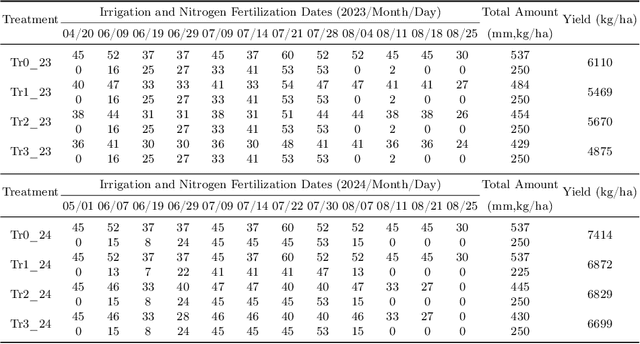
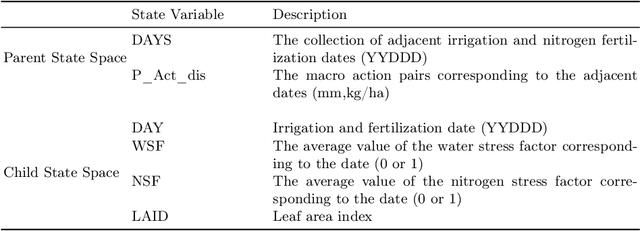

Effective irrigation and nitrogen fertilization have a significant impact on crop yield. However, existing research faces two limitations: (1) the high complexity of optimizing water-nitrogen combinations during crop growth and poor yield optimization results; and (2) the difficulty in quantifying mild stress signals and the delayed feedback, which results in less precise dynamic regulation of water and nitrogen and lower resource utilization efficiency. To address these issues, we propose a Nested Dual-Agent Reinforcement Learning (NDRL) method. The parent agent in NDRL identifies promising macroscopic irrigation and fertilization actions based on projected cumulative yield benefits, reducing ineffective explorationwhile maintaining alignment between objectives and yield. The child agent's reward function incorporates quantified Water Stress Factor (WSF) and Nitrogen Stress Factor (NSF), and uses a mixed probability distribution to dynamically optimize daily strategies, thereby enhancing both yield and resource efficiency. We used field experiment data from 2023 and 2024 to calibrate and validate the Decision Support System for Agrotechnology Transfer (DSSAT) to simulate real-world conditions and interact with NDRL. Experimental results demonstrate that, compared to the best baseline, the simulated yield increased by 4.7% in both 2023 and 2024, the irrigation water productivity increased by 5.6% and 5.1% respectively, and the nitrogen partial factor productivity increased by 6.3% and 1.0% respectively. Our method advances the development of cotton irrigation and nitrogen fertilization, providing new ideas for addressing the complexity and precision issues in agricultural resource management and for sustainable agricultural development.
PRISM of Opinions: A Persona-Reasoned Multimodal Framework for User-centric Conversational Stance Detection
Nov 15, 2025The rapid proliferation of multimodal social media content has driven research in Multimodal Conversational Stance Detection (MCSD), which aims to interpret users' attitudes toward specific targets within complex discussions. However, existing studies remain limited by: **1) pseudo-multimodality**, where visual cues appear only in source posts while comments are treated as text-only, misaligning with real-world multimodal interactions; and **2) user homogeneity**, where diverse users are treated uniformly, neglecting personal traits that shape stance expression. To address these issues, we introduce **U-MStance**, the first user-centric MCSD dataset, containing over 40k annotated comments across six real-world targets. We further propose **PRISM**, a **P**ersona-**R**easoned mult**I**modal **S**tance **M**odel for MCSD. PRISM first derives longitudinal user personas from historical posts and comments to capture individual traits, then aligns textual and visual cues within conversational context via Chain-of-Thought to bridge semantic and pragmatic gaps across modalities. Finally, a mutual task reinforcement mechanism is employed to jointly optimize stance detection and stance-aware response generation for bidirectional knowledge transfer. Experiments on U-MStance demonstrate that PRISM yields significant gains over strong baselines, underscoring the effectiveness of user-centric and context-grounded multimodal reasoning for realistic stance understanding.